Health and Safety Policy — Business Waste Removal Whitechapel
 This Health and Safety Policy sets out the commitment of our business waste removal service to maintain safe operations across all commercial collection and rubbish clearance activities. The policy applies to Business Waste Removal Whitechapel and associated commercial waste removal teams, contractors and temporary staff. It emphasises hazard identification, risk control, and ongoing monitoring to ensure the safety of employees, clients, and the public during rubbish collection and disposal tasks.
Our objectives include reducing workplace incidents, ensuring compliant waste handling, and protecting the environment. Responsibilities are clearly assigned: managers must ensure systems are in place and staff must follow procedures. Key duties include training, supervision and reporting. Managers will maintain records and review risk assessments. Frontline teams engaged in rubbish removal in the service area will be equipped and instructed to follow safe working practices. The following list summarises primary responsibilities:
- Risk assessment implementation
- PPE provision and maintenance
- Incident reporting and corrective action
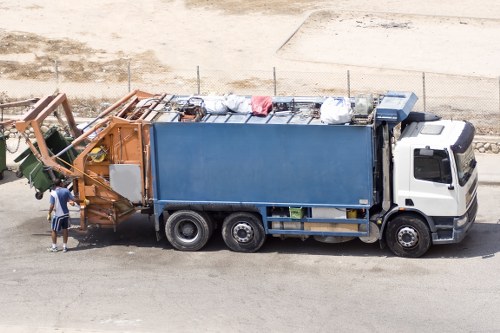 Risk assessment is integral to operations. We systematically identify hazards associated with waste types, lifting operations, vehicle movements and manual handling. Controls include standard operating procedures, team briefings, and supervised work during complex removals. All relevant activities are documented and reviewed periodically to reflect changes in waste streams, site conditions or equipment.
Scope, Training and Competence
Training underpins safe service delivery for rubbish company operations across our coverage area. Training programmes cover safe manual handling, correct segregation of recyclables and hazardous items, and use of lifting aids. Induction training is provided to every new operative and refresher sessions are scheduled regularly. Practical competency checks ensure that workers can safely operate compactors, tail lifts and other collection equipment commonly used in commercial waste removal Whitechapel projects.
 Supervisors will document training completion and maintain competency records. The company provides personal protective equipment (PPE) appropriate to each task, including gloves, high-visibility clothing, foot protection and eye protection where required. Staff are instructed in cleaning and inspection of PPE, and replacement is provided promptly. Emphasis is also placed on safe driving standards for refuse vehicles and secure load practices to prevent shifting during transit.
Communication channels are maintained to report hazards or near misses. Toolbox talks, safety briefings and written notices ensure teams are aware of emerging risks. Contractors and temporary workers must receive the same safety briefings and demonstrate understanding before undertaking site duties. The policy endorses a proactive reporting culture so that corrective measures can be taken swiftly.
Operations, Vehicles and Environmental Controls
Operational controls cover vehicle maintenance, site-specific procedures and waste segregation. Routine vehicle inspections, load checks and scheduled maintenance reduce mechanical failure risks. Staff must secure loads correctly and follow route protocols that minimise congestion and pedestrian exposure. The company also enforces procedures for identifying and isolating hazardous materials discovered during a collection, ensuring they are handled by appropriately trained personnel.
 Manual handling procedures are specified for lifting, carrying and transferring containers and bulky items. Mechanical aids are provided where practicable and team lifts are encouraged for heavy or awkward loads. The health and safety approach recognises the physical demands of waste collection and prioritises ergonomics to reduce musculoskeletal injury risks. Regular breaks and task rotation are implemented to manage fatigue and repetitive strain.
 Incident response and first aid arrangements are maintained across operations. All staff are briefed on emergency procedures including spills, fires and vehicle incidents, and trained first aiders are available during operational hours. Incidents are recorded, investigated and used to inform revisions of work practices. The policy also outlines procedures for compliance with environmental obligations, including appropriate segregation, containment and minimisation of pollution during routine rubbish removal and waste transfer activities.
Policy review and continuous improvement: This Health and Safety Policy for waste collection and rubbish removal services will be reviewed at least annually or whenever there is a material change in operations, equipment, workforce or regulatory expectations. Management will ensure audits and inspections are carried out and that corrective actions are tracked to completion. Employees and contractors are encouraged to contribute to improvements in safety performance and operational practices.
Commitment: The organisation is committed to maintaining a safe working environment for everyone involved in commercial and business waste removal activities, recognising that effective risk management and staff engagement are essential to delivering reliable, compliant and safe rubbish clearance services across the service area.
End of policy
